
In 2014, marketing strategist Mark Schaefer published an essay arguing that content marketing was not going to be a sustainable strategy forever.
At the time, this was a controversial idea. Content marketing was booming. More businesses were starting blogs, publishing videos, launching podcasts, and using social media to reach people directly.
But Mark saw a problem coming. As he explained when he joined me on the latest episode of Bad Community Advice:
“Whenever you have too much of something in any human, natural, or economic system, the system has to change. It has to accommodate this flood of whatever it is. The whole dynamics have to change.”
He called this Content Shock. Mark spoke about it in the context of marketing, but today, Content Shock is a problem for any business that depends on content to to capture attention and generate revenue.

Content has become an arms race
The barriers to creating and distributing content have collapsed. That has been great for creators. You no longer need a radio tower, television studio, printing press, or record label to reach an audience.
But it also means everybody else can create and distribute content, too. Now AI is making it possible to produce content at a scale that wasn't imaginable when Mark first wrote about Content Shock.
The supply of content can keep increasing, but the supply of human attention cannot. As Mark put it:
“When you have everybody creating content when it’s not unique anymore, and whenever you have all this competition, then it becomes an arms race.”
In an arms race, standing still isn't an option. Your competitors publish more, so you publish more. They improve their production, so you improve yours. They spend more to promote their content, so you spend more, too. Everybody keeps pouring more time and money into competing for the same finite supply of attention.
Mark described the inevitable conclusion: “Eventually at some point, somebody has to drop out or find another way around this.”
So what's the way around?
For years, the basic assumption behind many content businesses has been straightforward: create content, grow an audience, then monetize that audience.
Content Shock makes that model harder and harder to sustain. As more content competes for a finite amount of attention, reaching people requires more time, more money, or both. You can no longer assume that if you reach enough people, revenue will inevitably follow.
Content creators need another way to provide value, one that doesn't require them to constantly produce more themselves and isn't becoming more abundant every day.
Human connection is still scarce
We're producing more content than ever, but meaningful opportunities for people to connect with one another remain scarce. That's where community provides a different source of value.
When you build an audience, you're the engine. If you want people to keep coming back, you have to keep giving them something new to consume. But when you bring the right people together, they become a reason to come back. They form relationships, help each other, and share what they know.
Instead of creating all the value yourself, you create the conditions for people to create value for one another. As Mark told me:
“The highest level of emotional connection of all is a community. Because in a community, they don't just love you, they love each other.”
Content isn't going away. But when content is abundant and human connection is scarce, it makes sense to build a business around more than content alone.
Watch the Conversation
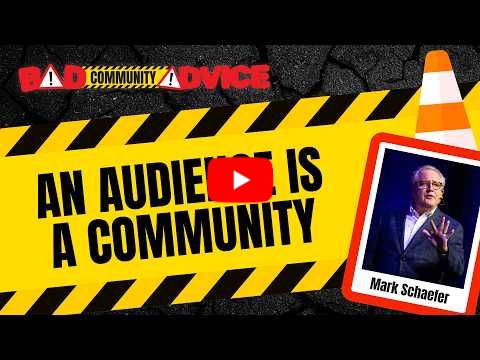
In the latest episode of Bad Community Advice, Mark and I dig into Content Shock, why audiences and communities aren't the same thing, and how community provides a way out of the content arms race.
|
Responses